Refrigerant Reference · 2026
R-22 Refrigerant Explained: Properties, Performance & Applications
A technical reference on the refrigerant that cooled a generation of American homes — what HCFC-22 is, how it behaves inside a running system, and where it stands in 2026.
R-22 refrigerant — known chemically as HCFC-22 or chlorodifluoromethane (CHClF₂) — is the single-component refrigerant that cooled the majority of American homes, heat pumps, and light-commercial buildings for more than four decades, and understanding how it actually works is the key to servicing, sourcing, or replacing any system that still runs on it. This guide is a technical reference rather than a shopping page: it explains what R-22 is at the molecular level, the thermodynamic properties that made it the industry's default, how it behaves inside a working refrigeration cycle, where it was used, how it compares with the refrigerants that have replaced it, and what safe handling and quality sourcing require today. If your question is instead about legality, current pricing, or the repair-versus-replace decision, our companion article on R-22 price, legality, and replacement in 2026 covers that ground in detail. Here, the focus is on the refrigerant itself.
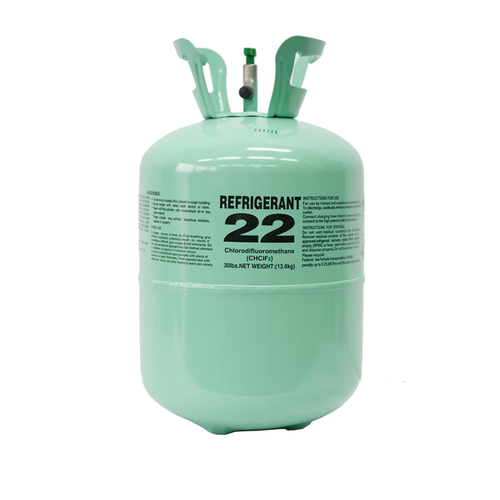
R-22 is a hydrochlorofluorocarbon (HCFC) refrigerant, chemical formula CHClF₂, once the standard charge for residential and commercial air conditioning, heat pumps, and medium-temperature refrigeration. It is a single-component refrigerant (not a blend), non-flammable and low-toxicity under ASHRAE Standard 34 (Safety Class A1), and pairs with mineral or alkylbenzene oil. Its ozone-depletion potential of 0.055 is why it was phased out: U.S. production and import ended January 1, 2020, so all R-22 sold since comes from reclaimed or pre-2020 stock.
What Is R-22 Refrigerant?
R-22 is the ASHRAE designation for chlorodifluoromethane, a halogenated hydrocarbon in which a single carbon atom is bonded to one hydrogen, one chlorine, and two fluorine atoms. Because it contains chlorine, it belongs to the hydrochlorofluorocarbon (HCFC) family — a transitional class of refrigerants that replaced the far more damaging chlorofluorocarbons (CFCs) such as R-12, while still carrying enough chlorine to affect the ozone layer. That chemistry is the whole story of R-22's rise and fall: the chlorine gave it excellent thermodynamic performance and material compatibility, and the same chlorine ultimately wrote its phase-out schedule.
For most of its working life, R-22 was marketed under brand names — most famously Freon 22, a Chemours (formerly DuPont) trademark. "Freon" is a brand, not a refrigerant type, which is why a data plate reading "Freon" tells you the manufacturer but not the chemical. When a technician, a supplier, or an equipment label refers to R-22, R22, or HCFC-22, they are all naming the same compound.
What made R-22 the workhorse of the HVAC industry was not any single exotic property but a rare balance of them: strong cooling capacity per unit of displacement, moderate operating pressures that ordinary copper-and-steel systems could contain, predictable behavior across a wide temperature range, and compatibility with the inexpensive mineral oils used in reciprocating and scroll compressors. From the 1970s until the 2010 cutoff on new equipment, it was simply the default.
The Chemistry and Physical Properties of R-22
The table below collects the properties that matter most when servicing, comparing, or sourcing R-22. These are the numbers a technician reasons with and the specifications that separate genuine product from contaminated or mislabeled material.
| Property | Value | What it means in practice |
|---|---|---|
| Chemical name | Chlorodifluoromethane | Single-carbon HCFC molecule |
| Chemical formula | CHClF₂ | One H, one Cl, two F |
| Refrigerant class | HCFC (single component) | Not a blend — no temperature glide |
| Molar mass | ≈ 86.47 g/mol | Heavier than air; pools low in unventilated spaces |
| Boiling point (1 atm) | −40.8 °C (−41.4 °F) | Evaporates readily at ordinary temperatures |
| Critical temperature | ≈ 96.1 °C (205 °F) | Above this it cannot be condensed by pressure alone |
| Critical pressure | ≈ 4.99 MPa (≈ 723 psi) | Sets the ceiling on high-side operation |
| Ozone depletion potential (ODP) | 0.055 | The property that placed it under the Montreal Protocol |
| Global warming potential (GWP) | 1,810 | One kg released ≈ 1.81 tonnes CO₂-equivalent |
| ASHRAE 34 safety class | A1 | Lower toxicity, no flame propagation |
| Compatible lubricants | Mineral oil, alkylbenzene (AB) | No POE conversion required for native systems |
Two of these figures deserve emphasis because they explain almost everything about R-22's history. The ODP of 0.055 is small next to the CFCs it replaced — R-12 has an ODP of 1.0 — but it is not zero, and under the Montreal Protocol any non-zero ozone impact eventually meant a phase-out. The GWP of 1,810 matters for a different reason: it is why R-22 is now also caught up in the broader climate conversation about fluorinated gases, and why its modern replacements are judged first on their global-warming numbers.
How R-22 Works Inside a Cooling System
Every vapor-compression system — a home air conditioner, a heat pump, a walk-in cooler — moves heat by exploiting one physical fact: a refrigerant absorbs a large amount of heat when it boils from liquid to vapor, and releases that heat when it condenses back. R-22 is good at this because its latent heat of vaporization is high and its boiling point sits conveniently below room temperature, so a modest pressure change is enough to make it boil in the indoor coil and condense in the outdoor coil.
The cycle runs in four stages. The compressor raises low-pressure vapor to high pressure and temperature. The condenser (outdoor coil) rejects heat as the hot vapor condenses to liquid. A metering device — a fixed orifice or a thermostatic expansion valve — drops the pressure sharply. The evaporator (indoor coil) then lets the cold liquid boil, pulling heat out of the air moving across it. R-22's properties allow this whole loop to operate at pressures ordinary residential equipment was built to handle.
Why the pressure–temperature relationship is central
For any pure refrigerant, pressure and saturation temperature are locked together: read one and you know the other. This is why a certified technician can measure suction and head pressures, convert them to temperatures, and diagnose the charge and the airflow without opening the system. The representative saturated figures below show how R-22 pressure tracks temperature.
| Temperature | Saturation pressure (approx.) | Typical role |
|---|---|---|
| 40 °F | ≈ 68.5 psig | Common evaporator range |
| 50 °F | ≈ 84 psig | Low-side operation |
| 60 °F | ≈ 102 psig | Mild-condition suction |
| 100 °F | ≈ 196 psig | Condensing range |
| 110 °F | ≈ 226 psig | Warm-day head pressure |
| 120 °F | ≈ 259 psig | High-load condensing |
The single-component advantage
Here is a property that separates R-22 from nearly all of its replacements and that many owners never hear about: R-22 is a pure compound, not a blend. It has zero temperature glide, meaning it boils and condenses at a single temperature for a given pressure. Practically, this has one large benefit — if an R-22 system loses charge through a small leak, a technician can often top it off with more R-22 without recovering and re-weighing the entire charge, because there is no risk of the blend "fractionating" and shifting composition. Zeotropic blends such as R-407C and R-410A behave differently: a leak can change their proportion, and best practice is to recover and recharge by weight rather than top off. This is a genuine servicing convenience of R-22 that helps explain why so many technicians preferred working with it.
Where R-22 Was Used: Applications
R-22's versatility put it into an enormous range of equipment. Its applications spanned three broad categories:
- Residential and commercial air conditioning. Split systems, packaged units, and rooftop equipment installed from the 1970s through 2009 overwhelmingly used R-22. This is still the largest installed base of legacy R-22 equipment in service.
- Heat pumps. Air-source heat pumps relied on R-22's wide operating range to both heat and cool, reversing the cycle seasonally.
- Medium-temperature refrigeration. Supermarket cases, cold rooms, beverage coolers, and process-cooling equipment used R-22 where temperatures did not need to reach the deep-freeze range served by refrigerants like R-404A.
Because residential HVAC systems typically last 15 to 20 years, a large fraction of that installed base is only now reaching end of life — which is precisely why demand for service-grade R-22 persists in 2026 despite production having ended years ago.
R-22 Performance Characteristics
Beyond the raw property table, several performance traits explain why R-22 held its position for so long — and set the benchmark that its replacements are measured against.
Capacity and efficiency. R-22 delivers strong volumetric cooling capacity at moderate pressures, which let manufacturers build compact, cost-effective equipment. Its coefficient of performance across typical air-conditioning conditions is high enough that most retrofit blends match it at best and slightly underperform it at worst.
Moderate operating pressures. R-22 runs at meaningfully lower pressures than R-410A, the refrigerant that first replaced it. This mattered enormously for equipment design and for field service — R-22 systems used standard components and were forgiving to work on. It is also why R-410A is not a drop-in for R-22: the higher-pressure refrigerant requires equipment rated for it.
Discharge temperature. R-22's discharge characteristics are well understood, and decades of field data mean technicians know exactly what "normal" looks like for a given system and ambient condition — a diagnostic advantage that newer refrigerants are only now accumulating.
Oil and Material Compatibility
A refrigerant is only half of the working fluid; the compressor's lubricant travels with it, and the two must be compatible. R-22's native lubricants are mineral oil and alkylbenzene (AB), both inexpensive and long-proven. This is a quiet but important part of R-22's appeal: systems designed for it did not need the polyol ester (POE) oils that most modern refrigerants require, and POE oils are considerably more hygroscopic — they absorb moisture aggressively, which introduces its own service risks.
Moisture is R-22's principal chemical enemy in service. Water in the system reacts with the refrigerant and oil to form acids that corrode metal and degrade the lubricant, which is why proper evacuation and a functioning filter-drier are non-negotiable during any service. Non-condensable gases such as air raise head pressure and reduce efficiency. These sensitivities are exactly why refrigerant purity — the subject of a later section — is not a cosmetic concern but a determinant of system life.
Safe Handling of R-22
R-22's ASHRAE Standard 34 classification of A1 means lower toxicity and no flame propagation — it is neither poisonous in normal concentrations nor flammable. That is genuinely reassuring, and it is worth correcting a common error: A1 refrigerants are not "mildly flammable." Mild flammability is the A2L class, which covers newer refrigerants such as R-32 and R-454B, not R-22.
Non-flammable does not mean hazard-free, however. R-22 carries two real handling risks that have nothing to do with fire:
- Asphyxiation. R-22 is heavier than air and can displace oxygen in confined or poorly ventilated spaces, causing suffocation without warning. Adequate ventilation during service is essential.
- Frostbite. Because liquid R-22 evaporates so rapidly, skin or eye contact can cause immediate cold burns. Protective equipment is required when handling the liquid phase.
These hazards, together with the legal requirement to recover rather than vent refrigerant, are why R-22 service is restricted to trained, EPA Section 608 certified technicians rather than being a task an owner can safely perform. Deliberately releasing R-22 to the atmosphere is a federal violation under Section 608 of the Clean Air Act, and the requirement to recover refrigerant applies to every service call and every system decommissioning.
R-22's Place in the 2026 Market
R-22 is no longer manufactured or imported into the United States. Under the Clean Air Act's HCFC phase-out — the U.S. implementation of the Montreal Protocol — new equipment designed for R-22 could not be built after 2010, and all domestic production and import ended on January 1, 2020. The refrigerant was never banned from existing equipment, and there is no federal requirement to replace a working R-22 system. What that means in practice is that every pound of R-22 available today comes from one of two sources: pre-2020 stockpile, or material recovered from decommissioned systems and reprocessed.
This is where quality specifications become the central sourcing question, and it is worth understanding the three grades that get discussed:
- Virgin R-22 is newly manufactured — a category that legally no longer enters the U.S. market, so remaining "virgin" material is simply aging pre-2020 stock.
- Recycled R-22 has been recovered and given basic on-site cleaning, then returned to the same system or owner. It is not tested against a purity standard and cannot be resold as a specification product.
- Reclaimed R-22 has been processed at a certified reclamation facility to strip out oil, moisture, and non-condensables, then verified against the AHRI 700 purity standard, making it functionally equivalent to new product for service use.
For any professional buyer, reclaimed material meeting AHRI 700 is the meaningful category — it performs to specification and comes from a documented, compliant supply chain. The pricing dynamics of that shrinking supply, and the four different "prices of R-22" that circulate online, are covered fully in our R-22 price and legality guide.
The refrigerants that replaced R-22
The transition away from R-22 has already run through one full generation and is entering a second. R-410A became the dominant replacement in new residential and commercial air conditioning, but as a high-GWP HFC it is itself being phased down. Since January 1, 2025, new residential and light-commercial air-conditioning equipment in the U.S. must use refrigerants with a GWP under 700, which has pushed the market toward lower-GWP options such as R-32 and R-454B.
| Refrigerant | Type | GWP | ODP | Safety class | Relative pressure | Oil |
|---|---|---|---|---|---|---|
| R-22 | HCFC, pure | 1,810 | 0.055 | A1 | Baseline | Mineral / AB |
| R-407C | HFC blend | 1,774 | 0 | A1 | Near R-22 | POE |
| R-410A | HFC blend | 2,088 | 0 | A1 | Much higher | POE |
| R-32 | HFC, pure | 675 | 0 | A2L | Higher | POE |
| R-454B | HFC/HFO blend | 466 | 0 | A2L | Near R-410A | POE |
The pattern is clear: the industry has traded R-22's ozone impact for zero-ODP replacements, and is now trading down the global-warming numbers as well. Note that R-407C is the closest pressure match to R-22 and is often discussed for legacy systems, while R-410A and the newer A2L refrigerants belong to equipment engineered specifically for them.
Why Purity Matters When Sourcing R-22
Because R-22 now comes exclusively from reclaimed or aging stock, the difference between good and poor material is larger than it was when everything was virgin product. Contaminated refrigerant carries consequences that show up as system failures, not just as inefficiency:
- Moisture forms acids that corrode components and break down oil.
- Residual oil or wrong oil from a previous system disrupts lubrication and heat transfer.
- Non-condensable gases raise head pressure, cut capacity, and shorten compressor life.
- Composition drift from careless recovery changes how the charge behaves.
This is why sourcing from a supplier that provides AHRI 700-verified reclaimed R-22 with proper documentation is not a formality — it directly protects the equipment it goes into. It is also why every legitimate transaction is documented: under the sales restriction, refrigerant in containers over two pounds is sold only to EPA Section 608 certified technicians or the businesses that employ them, with the seller responsible for verification and record-keeping.
Sourcing R-22 for a Legacy System?
CRefri supplies R-22 and the full range of modern refrigerants from a U.S. warehouse, with dependable stock and fast delivery for HVAC professionals and eligible business buyers. Tell us your product, quantity, and destination, and our team will confirm availability and the right next step.
View R-22 RefrigerantFrequently Asked Questions About R-22 Refrigerant
What does R-22 stand for, and what is HCFC-22?
R-22 is the ASHRAE numbering designation for the compound chlorodifluoromethane, chemical formula CHClF₂. "HCFC-22" is the same substance named by its chemical family — hydrochlorofluorocarbon — while "R-22" and "R22" are the shorthand used in the field. All three refer to one identical refrigerant: a single-carbon molecule carrying one hydrogen, one chlorine, and two fluorine atoms. The chlorine is what defines it as an HCFC and what gave it a non-zero ozone-depletion potential.
What is the boiling point of R-22?
R-22 boils at approximately −40.8 °C (−41.4 °F) at standard atmospheric pressure. That low boiling point is exactly what makes it useful as a refrigerant: at the modest pressures inside an air-conditioning system, it readily evaporates in the indoor coil to absorb heat and condenses in the outdoor coil to release it. Its critical temperature is around 96 °C (205 °F), above which it can no longer be condensed by pressure alone.
Is R-22 a blend or a single refrigerant, and why does it matter?
R-22 is a single-component refrigerant — a pure compound, not a mixture. This matters in service because it has zero temperature glide and cannot fractionate. If an R-22 system develops a small leak and loses charge, a technician can often add R-22 to bring it back to charge without recovering the entire system. Zeotropic blends such as R-407C and R-410A can shift composition when they leak, so they are generally recovered and recharged by weight rather than topped off. This is one of the practical reasons technicians found R-22 straightforward to work with.
What are normal operating pressures for an R-22 system?
Because pressure and saturation temperature are linked for a pure refrigerant, R-22 pressures depend heavily on operating and ambient conditions. As a rough guide, low-side (suction) saturation sits near 68 psig at a 40 °F coil temperature, while high-side (condensing) pressure climbs with outdoor temperature — roughly 196 psig at 100 °F and about 259 psig at 120 °F. These are reference values only. Correct charging is done against the specific equipment manufacturer's specifications using measured superheat and subcooling, and must be performed by an EPA Section 608 certified technician.
What type of oil does R-22 use?
R-22 systems were designed to run on mineral oil or alkylbenzene (AB) lubricant. This is a meaningful difference from most modern refrigerants, which require polyol ester (POE) oil. POE oils absorb moisture far more aggressively than mineral oil, which is one of the reasons converting an R-22 system to certain replacements involves an oil change, a system flush, and careful attention to moisture control rather than a simple refrigerant swap.
Is R-22 the same as Freon?
Not exactly — "Freon" is a brand name, historically owned by DuPont and now by Chemours, that has been applied to several different refrigerants including R-12, R-22, and R-410A. So "Freon 22" is R-22, but "Freon" on its own identifies a manufacturer's product line rather than a specific chemical. When precision matters — sourcing, servicing, or comparing refrigerants — the R-number or the chemical name is what to rely on, because the same brand covered multiple incompatible refrigerants over the decades.
Why was R-22 phased out?
R-22 was phased out because it depletes stratospheric ozone. Its ozone-depletion potential is 0.055 — small compared with the CFCs it replaced, but not zero. Under the Montreal Protocol and its U.S. implementation through the Clean Air Act, ozone-depleting substances were scheduled for elimination, which is why new R-22 equipment could not be built after 2010 and U.S. production and import ended on January 1, 2020. Its relatively high global-warming potential of 1,810 has since kept it relevant to the separate climate-driven phase-down of fluorinated gases as well.
What refrigerant replaced R-22?
In new equipment, R-410A became the primary successor to R-22 for residential and commercial air conditioning, though it operates at much higher pressure and requires equipment built for it. R-410A is now itself being phased down as a high-GWP HFC: since January 1, 2025, new U.S. residential and light-commercial air-conditioning systems must use refrigerants with a GWP below 700, moving the market toward lower-GWP options such as R-32 and R-454B. For existing R-22 systems specifically, several HFC retrofit blends exist — R-407C is the closest pressure match — but each involves trade-offs covered in our dedicated replacement guide.
This article is educational and is not legal or engineering advice. Refrigerant purchase, handling, and service in the United States are regulated under Section 608 of the Clean Air Act, and requirements vary by state and by equipment type. Refrigerant work on a stationary system must be performed by an EPA Section 608 certified technician.