Important: This article is educational and is not legal advice. Refrigerant purchase, handling, and service are regulated under Section 608 of the Clean Air Act, and requirements vary by state and by the type of equipment involved. Refrigerant work on a stationary system must be performed by an EPA Section 608 certified technician.
The short answer is yes — your R-22 system is legal to own, operate, and service in 2026. Production and import of R-22 refrigerant in the United States ended on January 1, 2020 under the Clean Air Act HCFC phase-out, but the EPA never banned existing equipment, and the agency's own guidance to equipment owners confirms that HCFC-22 can continue to be used in existing residential air conditioning systems. What changed is who is allowed to buy it: containers larger than two pounds may only be sold to EPA Section 608 certified technicians. If a contractor has told you the system must be replaced because R-22 is illegal, that statement is wrong as a matter of law.

The second point this guide makes is the one refrigerant suppliers rarely put in writing: the price you have been quoted may bear no relationship to the price someone else was quoted, because the industry routinely uses one word for four different numbers. We reviewed published 2026 R-22 pricing across eight HVAC and refrigerant supplier pages and found per-pound figures ranging from roughly $8 to $700 — an 87-fold spread, sometimes with contradictory numbers on the same domain. That is not market volatility. It is cylinder list price, wholesale price, installed contractor rate, and emergency small-quantity fill all being quoted as "the price of R-22."
And the third point is the one worth taking seriously before you spend anything: every refrigerant marketed to you as an R-22 replacement is a hydrofluorocarbon, and every one of them is already scheduled for phase-down under the AIM Act. One of the most widely recommended retrofit blends carries a higher global warming potential than the R-22 it replaces. A retrofit performed in 2026 buys service continuity. It does not buy a regulatory exit, and it is not, on the evidence, an environmental upgrade.
The Short Answer
Owning and servicing an R-22 system is legal in 2026 — the constraint is not legality, it is who can buy the refrigerant and what a declining supply does to the price.
Legal throughout: The 2020 action ended production and import of new R-22. Existing equipment, existing refrigerant, and the act of recharging a system were never prohibited. There is no federal requirement to replace a working R-22 unit.
Restricted at the point of sale: Under 40 CFR Part 82 Subpart F, R-22 in containers over two pounds may only be sold to EPA Section 608 certified technicians or businesses employing them. The verification burden sits with the seller, not the buyer.
The real caution: A system that needs refrigerant has a leak, because these are sealed systems. Repeatedly paying installed-rate prices to refill a leaking unit is the single most expensive way to own R-22 equipment — and no retrofit fixes a leak either.
What the 2020 Phase-Out Actually Banned
Two separate actions, routinely collapsed into one
The confusion around R-22 comes from two distinct regulatory events being remembered as a single ban. New equipment designed to use R-22 could no longer be manufactured after 2010. Separately, new R-22 could no longer be produced or imported into the United States after January 1, 2020. Neither action touched the installed base.
This distinction matters commercially, because "banned" and "phased out" carry different consequences. A ban makes a substance illegal to produce, sell, or use. A phase-out is a scheduled reduction that grandfathers existing equipment and permits continued service supply. R-22 sits in the second category, with one modification: new supply stopped entirely, so continued service depends on reclaimed material and pre-2020 stock.
Jan 1, 2020 — the date US production and import of R-22 ended
0.055 — R-22's ozone depletion potential, the property that placed it under the Montreal Protocol
1,810 — R-22's 100-year global warming potential (IPCC AR4), meaning one kilogram released equals roughly 1.81 metric tons of CO2
What remains illegal
Venting is the line that has not moved. Under Section 608, refrigerant must be recovered during service and either recycled on site or sent to a certified reclaimer. Deliberate release to the atmosphere is a federal violation, and it applies to every technician, every service call, and every system decommissioning — including one where the equipment is being scrapped.
What "still legal" does not mean
Legal availability is not the same as practical availability. Every pound of R-22 sold since 2020 came from reclamation or existing stock, which means supply is finite, declining, and priced accordingly. The question facing most owners in 2026 is not whether they may continue using R-22, but for how many more seasons doing so remains the cheaper option.
Why You Cannot Buy It: The Restriction Falls on the Seller
The rule, and who it binds
Under 40 CFR Part 82 Subpart F, refrigerant may only be sold to technicians certified under EPA Section 608 for stationary equipment or Section 609 for motor vehicle air conditioning, and each may only purchase refrigerant appropriate to the equipment their certification covers. R-22 in a home air conditioner is stationary equipment, so Section 608 applies. The only broad exception — small cans of two pounds or less of substitute refrigerants with self-sealing valves — is written for DIY automotive work and does not reach R-22 for residential HVAC.
The detail most buyers miss is where the legal exposure sits. EPA guidance on the refrigerant sales restriction states that the seller must verify the buyer either holds Section 608 certification or employs someone who does, and that selling to a non-compliant buyer can trigger enforcement action against the seller or the seller's company. "Seller" is defined broadly enough to cover anyone selling, distributing, or offering refrigerant for sale. Wholesalers must additionally retain invoices recording purchaser name, sale date, and quantity purchased.
What a compliant transaction looks like
A legitimate supplier collects a certification number and documentation before shipping, and keeps those records against the transaction for inspection. A supplier that lets you tick a checkbox affirming certification without collecting anything is not meeting the standard — and buying from one leaves both the transaction record and your system's service history on unstable ground. If you are sourcing refrigerant and no one asks for your card, that is a signal about the seller, not a convenience.
[COMPLIANCE-SLOT: describe your own verification process here.]
What this means if you are a homeowner
You cannot legally buy R-22 for your own system, and you cannot legally add it yourself. This is not a licensing formality that a determined owner can work around; it is a sales restriction with the enforcement weight placed on whoever sells to you. The practical path is a certified contractor, and the useful thing you can control is understanding what you are being charged for — which is the subject of the next section.
The $8-to-$700 Problem: Four Prices Called the Same Thing
Why published figures contradict each other
Across eight HVAC and refrigerant supplier pages published or updated in 2026, per-pound R-22 figures ranged from about $8 to about $700. Two of those figures appeared on the same domain in different articles. The spread is not evidence of a chaotic market. It is four distinct price calibers reported without labels.
| What is being quoted | What it includes | Published 2026 figures |
|---|---|---|
| Cylinder list price ÷ net weight | Refrigerant only, before tax, freight, or cylinder deposit | A 30-lb cylinder listed at $620 works out to roughly $20.67/lb (Royal Refrigerants, 2026) |
| Wholesale / distributor price | What a certified contractor pays at the supply house | $40–$75/lb (RefrigerantTrack, 2026) |
| Installed contractor price | Refrigerant plus labor, recovery, and the service call | $80–$150/lb standard; up to $250/lb for emergency or low-availability markets (RefrigerantTrack and Royal Refrigerants, 2026) |
| Small-quantity or emergency fill | 1–5 lb top-offs, after-hours or peak-season rates | Highest per-pound tier; after-hours rates commonly 1.5–2× standard |
The number that appears on your invoice
For a homeowner, only the installed contractor price is real, because that is what gets billed. A typical residential split system holds 3 to 6 pounds. At $90 to $150 per pound installed, a full recharge lands roughly between $270 and $900 for refrigerant alone, before leak diagnosis and recovery labor. Comparing that invoice against a cylinder price found online will always look like overcharging, and usually is not — the two numbers were never measuring the same thing.
Why the price only moves one direction
Supply is fixed and declining, since nothing new enters the market. Demand persists because residential HVAC systems typically last 15 to 20 years, which puts equipment installed through the 2000s at end of life now rather than a decade ago. Reclaimed volume grows as those systems are decommissioned, but it grows from a shrinking base. Planning around a price that rises every season is more useful than planning around a specific figure.
What Can Actually Replace R-22
The retrofit options, with their trade-offs stated
Several HFC blends are marketed as R-22 retrofits. Each trades away capacity, efficiency, or labor, and none is a genuine drop-in despite how the category is usually described.
| Refrigerant | GWP (AR4) | ODP | ASHRAE 34 | Oil | Performance vs R-22 | Retrofit work |
|---|---|---|---|---|---|---|
| R-22 (HCFC-22) | 1,810 | 0.055 | A1 | Mineral / alkylbenzene | Baseline | None — reclaimed supply only |
| R-407C | 1,774 | 0 | A1 | POE required | Close capacity match; 11 °F temperature glide affects TXV and superheat readings | Oil change from mineral to POE, system flush, critical elastomeric seal replacement |
| R-438A (Freon MO99) | 2,264 | 0 | A1 | Mineral, AB, or POE | Cooling capacity 6–8% below R-22 across evaporator temperatures | Usually no oil change; seal inspection recommended |
| R-422D | 0 | A1 | Mineral tolerant | System COP ~20% below R-22 in one chiller study; discharge temperature 20 °C lower | Minimal | |
| R-421A | 0 | A1 | Mineral tolerant (lubricant in blend) | Minimal | ||
| R-410A | 2,088 | 0 | A1 | POE | Not a retrofit — operates at far higher pressure | Requires full equipment replacement |
| R-454B (new equipment) | 466 | 0 | A2L | POE | Current new-system standard | Full replacement |
The oil-change question the manufacturers openly disagree on
Chemours states that retrofitting to Freon MO99 (R-438A) requires no oil change, and a 2010 Purdue International Refrigeration and Air Conditioning Conference paper by Allgood and Lawson supports the claim, reporting R-438A compatible with mineral oil, alkylbenzene, and polyol ester lubricants, so that in most cases no lubricant change is needed.
Arkema, a competing manufacturer, argues the opposite in its own technical literature: that R-438A and R-427A are HFCs without strong affinity for mineral oil, that the best lubricant for any R-22 replacement is POE, and that claiming a single refrigerant substitutes equally for the original across all applications is inaccurate and misleading.
Both positions hold, and the resolution is architectural rather than chemical. Simpler systems and systems with oil separators circulate enough oil to run acceptably on the original lubricant. Systems with long line sets, flooded evaporators, or low-temperature operation return oil poorly and are far less forgiving. A technician who inspects the system before naming a blend is doing the job correctly. One who names the same "best" retrofit for every system is quoting a catalogue.
What a retrofit does not accomplish
| What owners expect | What actually happens | The better approach |
|---|---|---|
| Retrofit will stop the refrigerant loss | A retrofit changes the refrigerant, not the leak. The new charge escapes through the same failure point | Locate and repair the leak first; treat retrofit as a separate decision |
| Retrofit will lower the power bill | Retrofit blends match or slightly underperform R-22. SEER is a function of the equipment, not the charge | If operating cost is the complaint, price new equipment |
| Retrofit is the environmentally responsible choice | R-438A's GWP of 2,264 is roughly 25% higher than R-22's 1,810 | If climate impact is the driver, only new low-GWP equipment delivers it |
| Retrofit ends the regulatory exposure | Every blend in the table is an HFC covered by the AIM Act phase-down | Weigh retrofit cost against remaining equipment life, not against permanence |
| Any listed alternative will work in any system | Oil return, glide, and capacity behave differently by system architecture | Require a system-specific recommendation in writing before authorising work |
The Hidden Risk: Retrofitting Into the Next Phase-Down
This is the section that matters most, and the one no refrigerant supplier will write.
The retrofit market is built on a reasonable premise: R-22 supply is shrinking, so convert the system to something still in production. The premise holds. What gets left out is where that "something" sits on its own regulatory timeline.
The arithmetic that does not appear in retrofit marketing
Every blend commonly sold as an R-22 replacement — R-407C, R-438A, R-421A, R-422D — is a hydrofluorocarbon. Every one falls under the AIM Act HFC phase-down, which targets an 85% reduction in US HFC consumption by 2036. The refrigerant being recommended as the durable answer to a phase-out is itself being phased down on a published schedule.
The environmental framing is harder still. R-438A carries a 100-year GWP of 2,264 against R-22's 1,810. Converting a system from R-22 to MO99 raises the global warming potential of the charge by roughly 25%. R-407C, at 1,774, is essentially level with R-22 rather than an improvement. Whatever the case for these blends — and there is a real one, built on service continuity and avoided capital cost — the environmental case is not it.
Why this changes the decision rather than ending it
None of this makes retrofitting wrong. On a nine-year-old system with a repaired leak and a sound compressor, converting to a blend that is still in production is straightforwardly the cheaper path, and the AIM Act phase-down will not meaningfully constrain service supply within that equipment's remaining life. The reasoning holds because the timeline is short.
It stops holding when the retrofit is sold as permanence. A conversion performed on a fifteen-year-old system is paying retrofit labor to move from a refrigerant that is gone to a refrigerant that is going, on equipment that may fail for unrelated reasons within a few seasons. The question that determines whether a retrofit was worth it is not "is this refrigerant still available" but "how many more years does this equipment have, and does the conversion cost less than those years are worth." Suppliers answer the first question readily. The second one is yours.
Practical Decision Guidelines
What to do, by system age and condition
| Situation | Recommended path | Why |
|---|---|---|
| Under 10 years old, leak repairable, compressor sound | Repair the leak, recharge with reclaimed R-22 | Reclaimed R-22 meeting AHRI 700 purity specifications is functionally equivalent to virgin product for service use; retrofit labor is not justified |
| 10–15 years old, leak repairable | Get a retrofit evaluation naming a specific blend for your specific system, with expected capacity change in writing; compare against a replacement quote | This is the only age band where retrofit economics are genuinely competitive |
| Over 15 years old | Price replacement first | Residential HVAC life expectancy is 15–20 years; a conversion may outlast the equipment it was performed on |
| Compressor has failed | Replace the system | Compressor replacement on aged equipment frequently approaches the cost of new, and new equipment uses a currently supported refrigerant |
| Leak cannot be located, or is in the evaporator coil | Replace the system | Coil replacement plus retrofit labor plus refrigerant typically exceeds the value of continuing |
| Flooded evaporator or long line sets | Require a system-specific retrofit assessment, or replace | Oil return governs; "no oil change" retrofits are least reliable in exactly these configurations |
| Complaint is efficiency, not failure | Replace the system | No refrigerant change improves SEER; only equipment does |
How to identify what your system uses
- Locate the metal data plate on the side of the outdoor condensing unit, near the electrical panel.
- Look for the line labeled REFRIGERANT, REFRIG, or CHARGE. Manufacturers print the type inconsistently — R-22, R22, and HCFC-22 all mean the same thing.
- Check the manufacture date on the same plate. Residential units built before 2010 are very likely R-22.
- Do not rely on the word "Freon." Freon is a Chemours brand name that has covered R-12, R-22, and R-410A among others, so it identifies a manufacturer rather than a refrigerant.
- Look for retrofit stickers. A previous conversion should have been labeled at the time of service with the new refrigerant and lubricant.
- If the plate is missing or unreadable, have a Section 608 certified technician confirm by pressure-temperature readings before anything is added.
[CTA-SLOT: insert your offer here.]
Conclusion: Legal, Yes — but Ask the Better Question
Is R-22 still legal in 2026? Yes. Production and import ended on January 1, 2020, but existing equipment was never banned, reclaimed R-22 remains legally available, and no federal rule requires you to replace a working system. The constraint is at the point of sale: containers over two pounds go only to EPA Section 608 certified technicians, with the verification burden on the seller.
The better question is what a declining supply does to the arithmetic of keeping the system. R-22 pricing only moves one direction, and the four price calibers circulating online make the market look more chaotic than it is. Know which number you are being quoted, and the invoice stops being a surprise.
The most important caution is not about legality at all. Retrofit blends are sold as the durable answer to a phase-out, and they are HFCs on their own phase-down schedule — one of them at a higher global warming potential than the R-22 it replaces. That does not make retrofitting wrong. It makes it a calculation about remaining equipment life rather than a permanent solution.
Service it with reclaimed R-22 while the system is young. Evaluate a retrofit in the middle years, with the specifics in writing. Price replacement once the equipment is near the end of its life — and treat any supplier who skips that arithmetic as someone quoting a catalogue rather than assessing your system.
Frequently Asked Questions
Can a homeowner legally buy R-22 refrigerant?
No. Under 40 CFR Part 82 Subpart F, R-22 in containers larger than two pounds may only be sold to EPA Section 608 certified technicians or to businesses that employ them. The small-can exception people sometimes cite — containers of two pounds or less with self-sealing valves — was written for substitute refrigerants used in motor vehicle air conditioning and does not extend to R-22 for a home HVAC system. The point most often misunderstood is where the legal exposure sits: EPA guidance places the verification duty on the seller, who must confirm the buyer is certified or employs someone certified, and who can face enforcement action for selling to a non-compliant purchaser. That is why a legitimate supplier will ask for a certification number and retain it against the transaction record. If a seller is willing to ship R-22 to you without collecting anything, the compliance problem is theirs, but the consequences reach the transaction you are part of.
Is it illegal to run an R-22 air conditioner in 2026?
No. The January 1, 2020 action ended US production and import of R-22; it did not ban the equipment, the refrigerant already in circulation, or the act of recharging a system. EPA guidance to equipment owners states directly that HCFC-22 can continue to be used in existing residential air conditioning systems, and that recovered and pre-2020 material will help meet the needs of those systems. There is no federal requirement to replace a functioning R-22 unit, and a contractor who says otherwise is wrong on the law. What is illegal, and has not changed, is venting: refrigerant must be recovered during service and either recycled on site or sent to a certified reclaimer, and deliberate release to the atmosphere is a federal violation. The decision about whether to keep an R-22 system is economic, not legal.
Why do R-22 prices online vary so much?
Because four different numbers are all being called "the price of R-22." A cylinder list price divided by net weight gives the raw product cost and can land near $20 per pound. A wholesale or distributor price, which is what a certified contractor pays at the supply house, commonly runs $40 to $75 per pound. An installed contractor price includes labor, recovery, and the service call and typically reaches $80 to $150 per pound, higher in emergency or low-availability situations. Small-quantity and after-hours fills sit at the top of the range, with after-hours rates often 1.5 to 2 times standard. Reviewing eight supplier pages published in 2026, we found figures spanning roughly $8 to $700 per pound, sometimes contradicting each other on the same domain. If you are a homeowner, the installed contractor price is the only one that will appear on your invoice.
Is R-22 flammable?
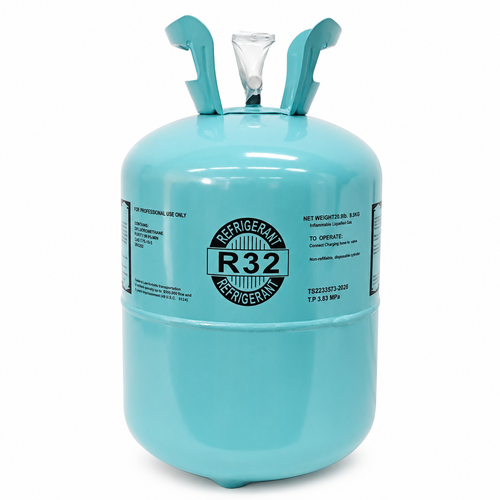
No. R-22 carries an ASHRAE Standard 34 safety classification of A1, where "A" indicates lower toxicity and "1" indicates no flame propagation. Several sources online incorrectly describe A1 refrigerants as mildly flammable, which conflates two different classes: mild flammability is A2L, the category that covers newer refrigerants such as R-454B and R-32. R-22 does carry genuine handling hazards that are unrelated to flammability. It can displace oxygen and cause asphyxiation in confined or poorly ventilated spaces, and liquid contact can cause frostbite because of how rapidly it evaporates. Recovery equipment and appropriate ventilation are required during service, which is part of why the work is restricted to certified technicians rather than being a matter of following instructions carefully.
Does retrofitting to an alternative reduce cooling performance?
Usually, slightly, and the amount depends on the blend and the system. Published data for R-438A shows cooling capacity 6 to 8 percent below R-22 across low, medium, and high evaporator temperatures. One direct-expansion water chiller study found R-422D delivered system COP roughly 20 percent below R-22, though it also ran a discharge temperature 20 °C lower, which is favourable for compressor life. R-407C is generally the closest capacity match but introduces about 11 °F of temperature glide, which changes how superheat and subcooling readings must be interpreted and can affect TXV behaviour. Because the magnitude varies by system architecture, operating temperature, and line set configuration, a general recommendation is worth less than a system-specific assessment. Ask any contractor proposing a retrofit to state the expected capacity change for your equipment in writing.
Are R-22 replacement refrigerants better for the environment?
Not necessarily, and in at least one common case the opposite is true. R-22 has a 100-year global warming potential of 1,810 under IPCC AR4. R-438A, widely marketed as the easiest R-22 retrofit, carries a GWP of 2,264 — roughly 25 percent higher. R-407C, at 1,774, is effectively level with R-22 rather than an improvement. What the retrofit blends do eliminate is ozone depletion potential: R-22 has an ODP of 0.055, and the HFC alternatives have none, which is the reason R-22 was targeted under the Montreal Protocol in the first place. But on climate impact specifically, retrofitting is at best neutral and can be a step backward. Every one of these blends is also subject to the AIM Act HFC phase-down targeting an 85 percent reduction in US HFC consumption by 2036. If reducing climate impact is the actual goal, only new equipment using a low-GWP refrigerant such as R-454B, at a GWP of 466, delivers it.
What is the difference between recycled, reclaimed, and virgin R-22?
Virgin R-22 is newly manufactured product, which has not been legally produced or imported in the United States since January 1, 2020; what remains in circulation is pre-2020 stock. Recycled R-22 has been recovered and cleaned on site with basic filtration, then returned to the same system or the same owner — it has not been tested against a purity standard and cannot be resold as a specification product. Reclaimed R-22 has been processed at a certified reclamation facility to remove oil, moisture, and non-condensables, then tested against AHRI 700 purity specifications, making it functionally equivalent to virgin product for service use. For a homeowner, reclaimed is the meaningful category: it is legally available, it meets the same specification as new product, and it is what a compliant supply chain delivers today.
Will R-22 eventually become unavailable?
Supply is finite and declining, but outright unavailability is not the near-term constraint. Reclaimed R-22 remains legally available, and reclamation volumes are replenished each time an older system is decommissioned and its charge recovered rather than vented — which is one practical reason the venting prohibition matters to owners as well as technicians. The realistic pressures are price and lead time. Since nothing new enters the market, the per-pound cost rises season over season, and regional availability tightens during peak summer demand in markets with long cooling seasons. Planning around a refrigerant that gets more expensive every year is more useful than planning around a date when it disappears.