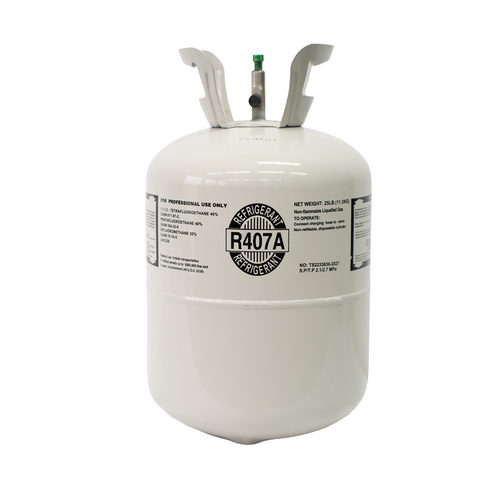
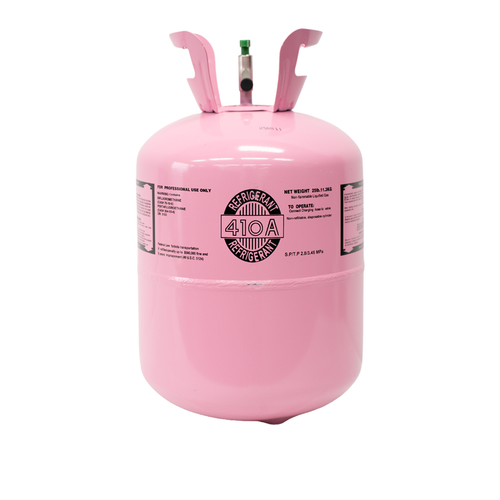
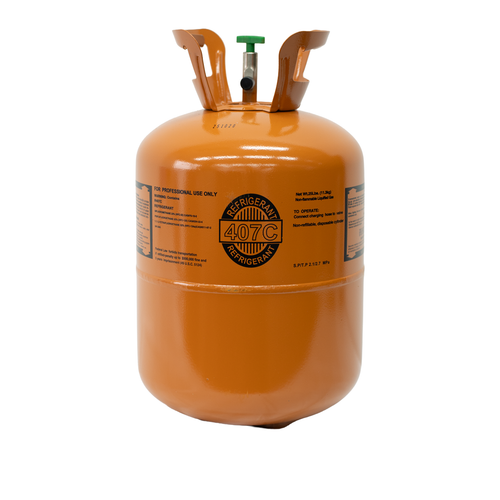
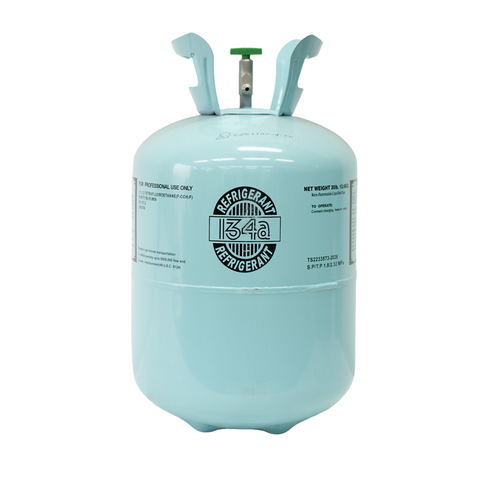
Important: This article is educational and is not legal or repair advice. Refrigerant sales are regulated federally under Section 609 of the Clean Air Act and separately by individual states, and state rules differ from federal rules in ways that affect what you can legally buy. Verify the requirements where you live before purchasing.
The short answer is that your vehicle takes one of two automotive refrigerants, and model year tells you which. Cars built from roughly the 1994 model year through 2020 almost all use R-134a; by the 1995 model year, every new vehicle sold in the United States with air conditioning had moved to HFC-134a. Vehicles from 2021 onward generally use R-1234yf, following EPA's 2015 decision to remove R-134a from the list of acceptable refrigerants for new motor vehicle air conditioning beginning with model year 2021. The years in between are a genuine mix. The two are not interchangeable, the service fittings are keyed to prevent mixing, and putting one in a system built for the other causes damage rather than cooling.

The second point this guide makes is the one most buying guides get wrong: federal law is not the whole law. Under EPA rules, small cans of two pounds or less with self-sealing valves can be sold to people without any certification for DIY use on their own vehicles — no card, no paperwork, no recordkeeping. Every article stops there. But Washington State has prohibited the sale of R-134a cans in that size range for MVAC recharging, and California requires that any R-134a small can be certified by the California Air Resources Board, carries a ten-dollar refundable deposit per can, and obliges retailers to post a bilingual placard. A can that is entirely legal to sell in one state may not be legal in another, which is why an order that ships nationwide is not the same thing as a product that is legal nationwide.
And the third point is the one worth taking seriously before you buy anything: an automotive air conditioning system is a sealed loop. It does not consume refrigerant. If yours is low, it is leaking, and adding refrigerant treats the symptom while the leak keeps running. The more consequential version of that problem is what many recharge kits contain alongside the refrigerant — stop-leak sealant, which can clog expansion valves and contaminate the recovery equipment a shop would use later. Some shops refuse to service systems they suspect have been treated this way. The can that cools your car this weekend can be the reason the invoice is larger in September.
The Short Answer
Model year tells you which refrigerant you need; federal law lets you buy it in small cans; your state may disagree; and a system that needs refrigerant has a leak.
Which automotive refrigerant you need: R-134a for most vehicles model year 1994 through 2020. R-1234yf for most vehicles from 2021 onward. Model years 2014 through 2020 are a real mix that varies by brand and by individual model — General Motors began with select Cadillac models in 2013 and went broad in 2017.
What you can buy: Cans of two pounds or less with self-sealing valves and unique fittings can be sold to anyone for DIY use on their own vehicle. Anything larger than two pounds requires evidence of EPA Section 609 technician certification, and wholesalers must retain an invoice recording purchaser name, sale date, and quantity.
Where that stops being true: Washington State has prohibited sale of R-134a MVAC cans in the two-ounce-to-two-pound range; R-1234yf cans remain available to Washington consumers. California requires CARB certification of the can itself, a ten-dollar deposit, and retailer placarding.
The real caution: Avoid any product containing stop-leak sealant. It can block expansion valves, contaminate professional recovery equipment, and cause a shop to decline the job — converting a small repair into a large one.
What Automotive Refrigerant Your Car Actually Uses
The model-year map, and where it breaks down
Three refrigerant generations have run through American vehicles, and the boundaries between them are cleaner at the start than at the end.
| Model years | Refrigerant | Confidence |
|---|---|---|
| Through 1993 | R-12 (CFC-12) | High — production ceased under the Montreal Protocol; systems still running have usually been retrofitted |
| 1994–2013 | R-134a | Very high — by the 1995 model year all new US vehicles with AC used HFC-134a |
| 2014–2020 | Mixed | Low — must verify per vehicle. GM began with select Cadillacs in 2013 and moved broadly in 2017; other brands transitioned on their own schedules |
| 2021 onward | R-1234yf (most), some R-744 or R-152a | High — EPA removed R-134a from the acceptable list for new MVAC beginning model year 2021 |
The 2015 rule is commonly described incorrectly
Most guides say the EPA mandated R-1234yf starting with model year 2021. What the agency actually did was remove R-134a from the list of refrigerants acceptable for new motor vehicle air conditioning from that model year forward. Manufacturers then chose their replacement, and most chose R-1234yf, though carbon dioxide (R-744) and R-152a are also permitted. The distinction matters for anyone buying: R-1234yf is the dominant answer, not the only legal one, and a small number of vehicles use something else.
1,430 — R-134a's 100-year global warming potential (IPCC AR4), with an atmospheric lifetime of roughly 13 years
4 — R-1234yf's global warming potential, with an atmospheric lifetime of about 11 days
2 lb — the container threshold above which EPA Section 609 certification is required
How to confirm before you buy anything
- Open the hood and find the AC specification sticker, usually near the compressor or on the radiator support. It states the refrigerant type and the factory charge weight explicitly.
- Cross-check the owner's manual if the sticker is missing, faded, or replaced.
- Look at the service ports. R-1234yf uses a larger keyed fitting that physically will not accept R-134a equipment, which is a deliberate design safeguard rather than a coincidence.
- For a 2014–2020 vehicle, do not infer from the model year alone. Confirm from the sticker or the manual, because two vehicles of the same year from the same manufacturer can differ.
- Check for retrofit labeling on an older vehicle. A converted R-12 system should carry a label recording the substitute refrigerant and lubricant.
- If nothing is legible, have a shop identify it. Refrigerant identifiers read the charge directly and cost far less than a contaminated system.
Why R-134a and R-1234yf Are Not Interchangeable
Different chemistry, different safety class, different service equipment
| R-134a | R-1234yf | |
|---|---|---|
| Chemical family | HFC (hydrofluorocarbon) | HFO (hydrofluoroolefin) |
| GWP (100-year) | 1,430 | 4 |
| Atmospheric lifetime | ~13 years | ~11 days |
| ASHRAE 34 class | A1 — low toxicity, non-flammable | A2L — low toxicity, mildly flammable |
| Lubricant | PAG oil, viscosity per manufacturer spec | PAG oil formulated for HFO systems |
| Service fittings | 1/4" low-side, 3/8" high-side quick-connect | Larger keyed fittings per SAE J2844; will not mate with R-134a equipment |
| System requirements | Standard MVAC design | SAE J639 compliance: flammable refrigerant warning label, high-pressure compressor cutoff, pressure relief devices, unique fittings |
| Regulatory trajectory | HFC subject to AIM Act phase-down — 10% reduction began 2022, 85% target by 2036 | HFO, not subject to the HFC phase-down |
| 2026 cost | Baseline | Budget at least double per service |
Retrofitting between them is not a supported path
An R-134a system cannot be converted to R-1234yf. The newer refrigerant's A2L classification carries system requirements — the compressor cutoff, the pressure relief provisions, the warning labeling, the fittings — that an R-134a vehicle was never built to satisfy. Vehicle manufacturers discourage conversion, and shops equipped for one refrigerant need dedicated recovery, recycling, and leak-detection equipment for the other rather than shared tooling.
Why the price gap exists and where it is going
R-1234yf costs meaningfully more per service in 2026, and budgeting at double the R-134a figure is a reasonable planning assumption. Two forces push in opposite directions. Production scale for R-1234yf continues to grow as more manufacturers enter, which narrows the gap. Meanwhile R-134a is an HFC under the AIM Act phase-down, which began with a 10 percent consumption reduction in 2022 and targets an 85 percent reduction by 2036, tightening its supply over time. The long-run direction is that the cheap option gets less cheap.
What Automotive Refrigerant You Can Legally Buy — and Where Your State Says Otherwise
The federal rule
Under 40 CFR Part 82 Subpart F, refrigerant sales are restricted to technicians certified under Section 608 for stationary equipment or Section 609 for motor vehicle air conditioning. Motor vehicle refrigerant carries a specific exception: small cans holding two pounds or less, fitted with unique fittings and self-sealing valves, may be sold to people without certification for DIY use on their own vehicles. These cans are also exempt from the recordkeeping requirement that applies to other refrigerant sales.
Above two pounds, the exception ends. A purchaser must present evidence of Section 609 certification, or evidence that the facility they are buying for employs at least one certified technician. Wholesalers must retain an invoice listing purchaser name, date of sale, and quantity, and keep it for three years.
Where the states diverge
This is the part that gets left out of buying guides, and it is the part most likely to affect an actual purchase.
| Jurisdiction | What applies to R-134a small cans | Practical effect |
|---|---|---|
| Federal baseline | Sale permitted to uncertified individuals; self-sealing valve and unique fittings required; no recordkeeping | DIY purchase is legal |
| Washington | Sale prohibited for cans holding more than two ounces and less than two pounds designed to recharge vehicle MVAC systems | R-134a DIY cans unavailable; R-1234yf cans remain available to consumers |
| California | Can must be CARB-certified for sale in-state; ten-dollar refundable deposit per can collected at retail; retailer must post an 8.5" × 11" placard in English and Spanish describing hazards, recharge references, and the deposit program | A can legal elsewhere may not be legal here; the return-and-deposit system must be operated |
| Other states | [需核实 — several states have adopted HFC rules modeled on CARB; verify individually before assuming the federal baseline applies] | Do not assume nationwide uniformity |
What this means if you are buying online
A seller shipping nationwide is not the same as a product that is legal nationwide. If you are in Washington and an R-134a can arrives at your door, the transaction did not become compliant because it shipped. If you are in California, a can without CARB certification does not qualify for sale in-state regardless of where the warehouse sits. The practical step before ordering is to check your own state's rule rather than the federal one, because the federal rule is the permissive floor and the states build upward from it.
[COMPLIANCE-SLOT: state your own state-level shipping policy here.]
The Hidden Risk: The Can That Cools Today Is Why the Bill Is Higher Later
This is the section that matters most, and the one no one selling recharge kits will write.
Automotive air conditioning is a sealed, pressurized loop. It is not designed to consume refrigerant, and it does not evaporate away with normal use. If the system is low, refrigerant left through a leak, and adding more sends the replacement out the same opening. That is the baseline problem with a recharge can, and it is the smaller of the two.
The sealant problem
Many over-the-counter recharge kits include stop-leak sealant alongside the refrigerant. The chemistry that seals a pinhole leak also blocks expansion valves and coats internal surfaces, and it does not stay inside your vehicle. When the system is later serviced, the sealant enters the shop's recovery machine, where it can damage the valves. Newer machines carry optional filters and contamination sensors specifically because of this, and some shops decline to service a system they suspect has been treated — which means the DIY can can cost you access to the repair, not just the repair.
The gauge problem
The pressure gauge on a consumer recharge kit reads the low side only. Low-side pressure varies with ambient temperature, engine speed, and humidity, which means it does not tell you how much refrigerant is in the system. Professional charging works by weight — the exact ounces or grams specified by the vehicle manufacturer, added after the system has been evacuated. A low-side gauge showing a low reading is not evidence of a low charge, and acting on it is how systems get overcharged. Overcharging strains the compressor and the condenser, and it is a failure mode that costs considerably more than the can saved.
What warm air actually indicates
A cabin that stays warm at idle is frequently a failing electric condenser fan or restricted airflow across the condenser rather than a refrigerant shortage. Adding refrigerant to a system that is already full, in response to a symptom caused by airflow, produces an overcharged system and an unresolved fault. The diagnostic order matters: identify why it is not cooling before deciding what to add.
Where DIY is genuinely reasonable
None of this makes a can the wrong answer in every case. On an older vehicle with a slow, known leak of a few ounces per year, where the owner has accepted that a proper repair is not economic, topping up with pure refrigerant and no sealant — ideally with a manifold gauge set reading both sides rather than the kit's low-side gauge — is a defensible maintenance choice. The distinction is between a deliberate decision made with the leak understood, and a can bought in the hope that the problem is refrigerant. The first is maintenance. The second is how a compressor gets replaced.
Practical Guidelines
Decision framework by situation
| Situation | Recommended path | Why |
|---|---|---|
| AC cooled fine last season, gradually weaker this season | Slow leak — have it located; top up with sealant-free refrigerant only if repair is being deferred deliberately | Gradual loss is the classic small-leak signature; the top-up is a decision, not a fix |
| AC stopped abruptly | Diagnose before adding anything | Sudden failure points to a component or a large leak; refrigerant will not address either |
| Cools while driving, warm at idle | Check the condenser fan and airflow first | A frequent cause is fan failure or blocked airflow, not charge level |
| Vehicle is 2014–2020 | Verify refrigerant type from the sticker before purchasing | This range is genuinely mixed; the fittings will stop a mistake, but only after the purchase |
| You are in Washington or California | Check state rules before ordering R-134a | Washington prohibits R-134a MVAC small cans; California requires CARB-certified cans with a deposit |
| Considering any product labeled stop-leak | Avoid | Sealant clogs expansion valves and contaminates shop recovery equipment; some shops will refuse the job |
| Vehicle uses R-1234yf and you want to DIY | Use an R-1234yf-specific kit; never attempt substitution | The fittings are keyed and the systems have different safety requirements under SAE J639 |
[CTA-SLOT: insert your offer here.]
Conclusion: Buy the Right One, in the Right State, for the Right Reason
Which automotive refrigerant you need is determined by model year, and the sticker under your hood settles it in about thirty seconds. R-134a covers most vehicles from 1994 through 2020, R-1234yf covers most from 2021 forward, and 2014 through 2020 requires you to look rather than assume. They are not interchangeable, and the keyed fittings exist because the industry expected people to try.
What you may legally buy depends on where you live, not only on federal rules. The federal exception for small cans is real and permissive — two pounds or less, self-sealing valve, no certification, no paperwork. But Washington has closed that door for R-134a, and California has added certification, a deposit, and placarding requirements on top of it. The federal rule is the floor. Your state builds on it.
And the reason you are buying matters more than either. A sealed system does not consume refrigerant, so a low charge is a leak by definition. Adding automotive refrigerant is a way of managing a leak you have chosen not to repair. It is not a repair, and if the product contains sealant, it can take the option of a proper repair off the table entirely.
Check the sticker before you buy. Check your state before you order. Skip anything with sealant in it. And if the system emptied itself quickly, find out why before you refill it.
Frequently Asked Questions
What refrigerant does my car use?
Model year is the first filter, and the underhood sticker is the confirmation. Vehicles from roughly the 1994 model year through 2020 almost all use R-134a; by the 1995 model year every new vehicle sold in the United States with air conditioning had transitioned to HFC-134a. Vehicles from 2021 onward generally use R-1234yf, because EPA's 2015 rule removed R-134a from the list of acceptable refrigerants for new motor vehicle air conditioning starting that model year. The problem range is 2014 through 2020, which is genuinely mixed and varies by brand and by individual model — General Motors began with select Cadillac models in 2013 and moved broadly in 2017, while other manufacturers transitioned on their own timelines. For any vehicle in that window, check the AC specification sticker near the compressor or on the radiator support, and cross-check the owner's manual if the sticker is unreadable.
Do I need a license to buy automotive refrigerant in the US?
Not for small cans. Under EPA rules, containers of two pounds or less fitted with unique fittings and self-sealing valves may be sold to individuals without any certification, for DIY use on their own vehicles, and these sales are also exempt from the recordkeeping requirements that apply to other refrigerant transactions. Above two pounds, the picture changes completely: the purchaser must show evidence of EPA Section 609 technician certification, or evidence that the business they are buying for employs at least one certified technician, and the wholesaler must retain an invoice recording purchaser name, sale date, and quantity for three years. Note also that Section 609 certification covers motor vehicle air conditioning only — it does not authorize purchasing refrigerant for stationary home or commercial HVAC equipment, which falls under Section 608.
Is R-134a banned?
No, but its runway is shortening. R-134a is no longer acceptable for use in new motor vehicle air conditioning systems from model year 2021 forward, and it is a hydrofluorocarbon subject to the AIM Act phase-down, which began with a 10 percent consumption reduction in 2022 and targets an 85 percent reduction by 2036. For the hundreds of millions of vehicles already on the road with R-134a systems, it remains the correct and compliant service refrigerant, and using anything else in an R-134a system is both technically improper and potentially a regulatory violation. What is changing is availability and price rather than legality, and separately, some states have restricted consumer sales: Washington prohibits R-134a MVAC cans in the two-ounce-to-two-pound range, while California requires those cans to be CARB-certified and sold with a refundable deposit.
Can I put R-1234yf in an R-134a car?
No, and the vehicle is built to stop you. The service fittings are physically different and keyed so that R-1234yf equipment will not mate with an R-134a system, a safeguard introduced deliberately to prevent cross-contamination during the transition. Beyond the fittings, R-1234yf carries an ASHRAE A2L classification, meaning it is mildly flammable, and systems designed for it must meet SAE J639 requirements including a flammable refrigerant warning label, a high-pressure compressor cutoff switch, and pressure relief provisions. An R-134a vehicle has none of these. Retrofitting between the two is not supported by vehicle manufacturers, and shops must maintain separate recovery, recycling, and leak-detection equipment for each refrigerant rather than sharing tooling. If a supplier suggests a conversion is possible, treat that as a reason to find a different supplier.
Why is R-1234yf so much more expensive than R-134a?
Budget at least double the R-134a figure for any R-1234yf service in 2026. The gap comes from production scale and patent history rather than from the refrigerant being harder to handle, and it has been narrowing as more manufacturers enter the market. Two partial offsets are worth knowing. R-1234yf systems are generally designed to need service less often than R-134a systems, which spreads the higher per-service cost across a longer interval. And the comparison moves over time in R-1234yf's favor, because R-134a is an HFC under the AIM Act phase-down while R-1234yf is a hydrofluoroolefin and is not subject to that schedule. The cheaper refrigerant today is the one whose supply is contracting on a published timeline.
Are DIY AC recharge kits bad for your car?
The refrigerant itself is not the problem; the additives and the measurement method are. Many kits include stop-leak sealant, which can block expansion valves and coat internal components, and which ends up in a shop's recovery machine when the vehicle is later serviced — newer machines carry optional filtration and contamination sensors specifically because of this, and some shops decline to work on systems they believe have been treated. Separately, the pressure gauge on a consumer kit reads the low side only, and low-side pressure varies with ambient temperature and engine speed rather than indicating charge level. Professional charging adds refrigerant by weight to the manufacturer's specification after evacuating the system. Acting on a low-side reading is the common route to overcharging, which strains the compressor and condenser. A sealant-free can used with a proper manifold gauge set, on a system with a known slow leak, is a far more defensible approach.
How often should a car's AC need recharging?
Ideally never, because an automotive air conditioning system is a sealed, pressurized loop that does not consume refrigerant during normal operation. If a system needs refrigerant, that refrigerant left through a leak. Very small losses over many years are common on older vehicles as seals and O-rings age, and topping up such a system periodically can be a reasonable maintenance decision when a full repair is not economic. But a system that empties within a season has a leak large enough to warrant locating, and refilling it repeatedly costs more than the repair while allowing moisture and air to enter through the same opening — moisture that can combine with refrigerant and lubricant to damage the compressor. The useful reframe is that recharging is leak management, not maintenance.
My AC blows cold while driving but warm at idle — do I need refrigerant?
Probably not. That specific pattern points most often to a cooling airflow problem rather than a charge problem. At highway speed, air moves through the condenser from vehicle motion alone. At idle, the electric condenser fan has to do that work, so a failing fan, a blocked condenser face, or debris restricting airflow produces exactly this symptom while the refrigerant charge is perfectly adequate. Adding refrigerant in response overcharges a full system and leaves the actual fault in place, which makes the cooling worse rather than better and puts load on the compressor. The correct first checks are whether the condenser fan runs when the AC is engaged, and whether the condenser fins are clean and unobstructed. Both are visual checks that cost nothing.